teaching and preaching to step into his calling. His actual work was making and selling tents as described in Acts 18:1-3.
Paul knew that he must work to support the ministry that God had entrusted him with. This was the very same Paul who wrote, “For even when we were with you, we gave you this rule: ‘The one who is unwilling to work shall not eat’” (2 Thessalonians 3:10).
I am blessed to serve as a “Timothy” under two “Pauls” who have dedicated their earlier lives to pastoral ministry and now to ministry to men. I have known Rev. Elmo Winters and Rev. Mark Lubbock for many, many years, and in my 53 years on earth, I have never met anybody else who has their level of dedication, perseverance, and effectiveness to advancing God’s Kingdom here on earth.
They both need our help. They need our prayers and words of affirmation. Today’s ministry leaders no longer sell tents but need financial support. We are stewards of the money God has blessed us with, and investing money from God back into the Kingdom is a blessing for the giver and the receiver.
These men have worked secular jobs their entire lives, as have their Proverbs 31 wives, and continue to do so. Much of their income goes to support their church first, their ministry second, and their family third with what is left. They all know the teaching of Paul in 2 Thessalonians better than anyone.
I think one of the greatest weapons that the enemy uses is to instill a sense of apathy within us that hinders us from supporting our church and ministries. Clearly, not all of us are called or able to support all ministries. However, many reading this blog have (1) a personal friendship with Mark and Elmo and are aware of their integrity and effectiveness in ministry, (2) an awareness of the positive impacts of the ministries that Mark and Elmo steward, and (3) knowledge of the need for financial support but fail to do so due to apathy. I am the first to admit that this has been one of my many faults for many years, but it stopped as I got more involved in ministry and grew closer to God, Mark, and Elmo.
Below, I want to share a few thoughts about Elmo and Mark’s ministry and how you can partner with them. I can assure you that each dime is prayerfully and wisely used.
As for my dear brother Mark, I encourage you to prayerfully consider joining me in donating to Rev. Mark Lubbock’s ministry – Gulf South Men. Please visit Gulf South Men’s website and GSMen.org to get a glimpse of the scope and impact of this ministry. Donations can be made HERE. Mark’s ministry helps men become disciples who are servant leaders as modeled by Jesus. His work cuts across boundaries of denomination, race, age, etc. His goal is to raise up Godly men that bring Christ into their homes and families and then out into the world. There have been dramatic impacts on men, but the ultimate beneficiaries are wives and families.
I have been blessed to have worked alongside Mark in ministry for several years and have seen the Holy Spirit work through him. If you have any questions or suggestions about the ministry, financial plans, etc., please give Mark a call at (225)252-3331 or email at marko@gulfsouthmen.org
To donate to Gulf South Men, please click HERE or mail a check to 7533 Quorum Dr, Baton Rouge, LA 70817.
Now for my dear brother Elmo, I also want to bring to your attention a dynamic ministry that is making a positive impact locally and nationally. The KINGDOM Group International, Inc. is a Baton Rouge based organization that is successfully addressing racial and cultural divisiveness. For the past several years, this ministry has held meetings and special events that have resulted in very positive changes in the area of unity and reconciliation.
Giving to the KINGDOM GROUP is easy. You can visit the Kingdom Group website and click the GIVE NOW button. Or, you can mail your donation to KINGDOM Group, 8733 Siegen Lane, Ste. 141, Baton Rouge, LA 70810. You can also call Rev. Elmo Winters at (225) 305-3006 or email at elmo@kingdomgroup.co for additional information.
Both of these ministries are 501(c)3 nonprofit organizations, so your gifts are tax deductible. Giving to any ministry is a second-mile donation. Your home church should receive your first mile, your tithe. After prayerful consideration, if you discern the ability and need to give more, then and only then should you give to any ministry. Please ask God what amount He would have you contribute, and whatever amount He puts on your heart is certainly the right amount, even if that amount is zero.
I pray that you can join me and call both of these godly men to learn how you can support and participate in their ministries. Please prayerfully consider becoming a monthly donor. Most importantly, I ask that you pray for God’s provision and protection for these men of Christ, their wives and families, and ministries.
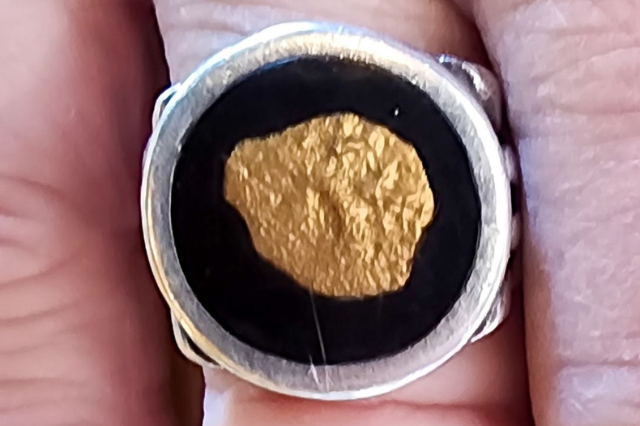
The image above is that of a mite coin embedded in a ring. The mite, also known as a lepton, was a Jewish coin and the smallest used in New Testament time. At the time of Mark’s writing, it was worth 1/64 of a denarius. A denarius was a day’s wage for a common worker. In today’s terms, it would be worth about 1/8 of a cent. In Luke 21:1-4, we learn about a poor widow’s offering. “As Jesus looked up, He saw the rich putting their gifts into the temple treasury. He also saw a poor widow put in two very small copper coins. ‘Truly I tell you,” He said, “this poor widow has put in more than all the others. All these people gave their gifts out of their wealth, but she, out of her poverty, put in all she had to live on.’” The same can be said of Brother Mark and Elmo.
Prayer: Thank you for the teachers and preachers that You have called, gifted, and equipped to help point us to You. Help us to consider financially supporting ministries that are bearing good fruit prayerfully. Most importantly, send your Spirit to remind us to pray daily for the success of all ministries that are seeking to glorify and honor You and point Your children to You. Amen.



 Getting To The Heart Of The Issue Over the years, I have spoken with many Christians and enjoyed having the opportunity to hear their testimony. Some are “intellectual Christians,” so to speak, and believe that science has proved the existence of Christ and therefore they also believe. Many have provided me with compelling arguments for their Christian faith. I also believe in Jesus and in science. However, at the heart of the issue is our heart. Do you believe in Him in your heart and seek him with your whole heart? Jesus taught us in Matthew 22:37, "Love the Lord your God...
 Judge Others Or Listen? “According to our Law we cannot condemn people before hearing them and finding out what they have done” (John 7:51 GNT). Those close to me will often tell me that I am naïve. I tend to be optimistic and take people at their word. I am not cynical. However, each day I am shocked by the level of hatred that I see among people. Hatred can be manifested in many ways such as physical violence, racism, oppression, etc. Hatred is born as a thought and grows into an action. During the thought process a judgment is made to justify...
 Gentleness is Strength “A gentle answer turns away wrath, but a harsh word stirs up anger” (Proverbs 15:1 NIV).I am blessed to have so many good friends. I enjoy talking with them and spending time with them, but I probably learn the most by watching them. I have seen many of them go through rough patches, but through it all they remain calm. Some people foolishly interpret their gentleness as weakness. These men are gentlemen. They are gentle, men, and very strong. There is no truer form of strength than gentleness. A common theme throughout Scripture is the need to surround yourself...